
Microsoft Word document [51.0 KB]
Unlearning the Christmas Story
Luke 2, Matthew 2
To learn this story, we must unlearn some things tradition has taught us…the man-made portions we have come to accept as fact.
- Mary rode on a donkey.
- An innkeeper broke the bad news.
- Jesus was born in a stable or a cave.
- Animals surrounded the manger.
- Jesus was born on Dec. 25.
- There were 3 wise men.
- The Magi were present at the manger.
- The star hovered over the manger.
The Bible never states any of this. I’m not trying to ruin Christmas for you, nor get you to throw away the nativity set on your table. Actually, it’s fun and educational to dig deeper into the truth that changed the world.
Don’t cast me out as a heretic without hearing me out, but I want to show you that it’s possible that the Magi actually were led, not to Bethlehem, but to Nazareth. [I don’t personally believe this, but I have to admit it may have happened that way]
Guardrails: This time of year we are grateful for them in case we slide off one side of the road or the other. We try to stay balanced in the middle to increase our chances of arriving alive. The nativity narratives in Matthew and Luke are like guardrails. Though the two evangelists share their own thoughtful accounts of Jesus’ birth, the Holy Spirit inspired both men, and both are 100% accurate. They sound different in places, but both got the story right—so their accounts fit together without sacrificing bits of one or the other.
Matthew fills out the story with information we can’t find in Luke, namely Joseph’s angel-dreams and the Magi narrative. So put a bookmark in Matthew 2 as well as Luke 2 so you can flip back and forth easily.
Reading about Joseph’s experience helps us make sense of Mary’s. In particular, it’s commonly believed that Mary, the unwed mother-to-be, faced unrelenting scorn and shame from everyone in Nazareth when her pregnancy was discovered. But Matthew tells us Joseph resolved to divorce her quietly (1:19). In other words, it’s possible that no one other than the angel Gabriel, Mary, and Joseph knew that she was expecting; otherwise, the divorce could hardly have taken place quietly. Now, it’s likely that her family knew. It’s certain that Elisabeth did.
Since Luke doesn’t include Joseph’s plan to divorce Mary or the visitation of an angel in Joseph’s dreams, we can’t be sure whether Mary told Joseph about her pregnancy and then went to stay with her cousin Elisabeth or if she shared the big news once she came back. It seems more likely, however, that Mary broke the news to Joseph after she returned from her trip, since Luke tells us Mary “went with haste” to see Elizabeth in Judah.
Coming back home to Nazareth at about three months along (Luke 1:56), Mary would have successfully avoided her family and neighbors during the worst of her morning sickness, but her body may have begun to show signs of pregnancy. Joseph’s decision concerning divorce would have needed to be made quickly, and that is the sense we gain from Matthew, who tells us that Joseph “did as the angel of the Lord commanded him” when he “woke from sleep” (1:24). So maybe they were married before many people knew. Still, you know how a rumor spreads.
Once Joseph resolved to believe God’s messenger—and his beloved—the couple began living together as husband and wife, though they did not consummate their marriage until after Jesus was born. Even though Mary’s baby bump may have begun to show just as she started her married life with Joseph, there’s little reason to believe it would have given her early pregnancy away. Mary would not have worn the types of tight-fitting clothes we wear today, and at the end of her first trimester, there would be little to notice anyway. And besides, once Joseph took Mary into his home as his wife, there would be no need to keep the secret.
There’s another reason to believe that Mary’s pregnancy was not considered scandalous, or possibly lost its traction over time. If the gossips in Nazareth had thought that Jesus was conceived in sin, such a rumor would have been prime ammunition for Jesus’ enemies to use during his preaching and healing ministry. Jesus’ opposition brought up other details from his background to “prove” he wasn’t even a prophet, let alone the Messiah (see John 7:52), yet we don’t hear an allegation of illegitimate birth leveled against Jesus. The closest we get to such an insinuation is in Mark’s gospel, when Jesus is preaching in the synagogue at Nazareth. Those gathered there are astonished at his teaching and say, “Is not this the carpenter, the son of Mary and brother of James and Joses and Judas and Simon? And are not his sisters here with us?” (6:3). But the people who ask these questions are not Pharisees or scribes or priests—the ones who would plot against Jesus years later. These are just regular folks, members of the community who had known Jesus most of his life. Most likely, they refer to him as “the son of Mary,” rather than of Joseph, because Joseph had already passed away.
Only Luke tells us about the Roman census that brought Joseph and Mary to Bethlehem, but he doesn’t tell us precisely when, on Mary’s pregnancy timetable, the trip took place. All he says is that while they were there, the time came for her to give birth (2:6). It’s often assumed that registering for the census would take only a few days, so it must have been that Mary was full-term when Joseph got the call to go to Bethlehem and that Mary came along because of the very real possibility she could give birth at any moment.
If Mary were about to have her baby, traveling would be a strange thing to do. It would make more sense, even if Joseph had been called out of town, for Mary to stay at home, surrounded by her family, perhaps being helped by her own mother.
I’d like to suggest that it was by choice that Mary went with Joseph to Bethlehem, that the couple may have been there for some time before Jesus was born, and that they may have even planned to stay in Bethlehem for good. I realize these suggestions may sound absurd given the Christmas plays we’ve all seen, but I think it makes the best sense of the details included in the two gospels.
Concerning Jesus, the angel Gabriel told Mary, “He will be great and will be called the Son of the Most High. And the Lord God will give to him the throne of his father David, and he will reign over the house of Jacob forever, and of his kingdom there will be no end” (Luke 1:32–33). Similarly, the angel who appeared to Joseph in a dream said, “That which is conceived in her is from the Holy Spirit. She will bear a son, and you shall call his name Jesus, for he will save his people from their sins” (Matthew 1:20–21). Mary and Joseph knew that Jesus would be the Messiah—and as faithful Jews, they would have known the Messiah was supposed to come from Bethlehem, David’s hometown.
I imagine there was a smile across Joseph’s face when he was ordered to Bethlehem for the census. So that’s how God is going to get us to Bethlehem so the baby can be born there, he must have thought.
So Mary and Joseph may have planned to relocate to Bethlehem for good—to raise Jesus there, in the same place where their ancestor David had grown up.
The family, of course, does return to Nazareth, and Jesus grows up there in Galilee. But there is a mention of other intentions in Matthew’s gospel. Sometime after Jesus is born in Bethlehem, an angel warns Joseph of Herod’s intention to kill the child and instructs him to escape to Egypt with Mary and Jesus. When Herod dies, the angel once again appears to Joseph and tells him it’s safe to return to Israel, so they make arrangements to head back. “But when [Joseph] heard that Archelaus was reigning over Judea in place of his father Herod, he was afraid to go there, and being warned in a dream he withdrew to Galilee” (2:22). Did you catch that? Joseph and Mary had planned to go back to Judea—not to Nazareth—when they returned home from Egypt. Their original trip to the City of David for the census, it seems, may have been originally intended as a permanent move.
Mary and Joseph’s arrival in Bethlehem is often portrayed as frantic, rather than as part of a plan. The scene usually plays out like this: They reach town late at night, only to search unsuccessfully for a comfortable place to stay; there’s “no place for them in the inn” (Luke 2:7). But at last the couple finds someone willing to let them hunker down in a stable, or perhaps a cave, so that Mary, now well into her labor, can give birth to the Son of God and place him in a manger. BTW, the cave idea is Catholic, for they found a cave in Bethlehem, built a church over it, and have claimed the site for tourism ever since.
But if the couple were planning on staying in Bethlehem for the duration, it only seems right that they would have made better travel arrangements. Joseph probably had family there. And even if moving to Bethlehem was only an afterthought dreamed up by Joseph while in Egypt, nowhere does the Bible suggest that Mary went into labor the night she and Joseph arrived in Bethlehem. Again, Luke simply tells us “while they were there, the time came for her to give birth” (2:6). They may have arrived a day, a week—or even longer—before it was time for Mary to have her baby. There’s simply no reason to believe that Mary and Joseph were in a panic or that God’s provision for the couple was meager in any way. I’m sure there were a few surprises for Mary and Joseph the night Jesus was born but something more in line with what other expectant parents go through.
Some will object that since the couple tries to find lodging at an inn, they must have just arrived in Bethlehem as Mary started to feel contractions—and the use of a manger for a makeshift cradle shows that Jesus was born in a stable or a cave, surrounded by animals. But the word that has been traditionally translated “inn” in Luke’s gospel is probably better understood as “guest room.” It’s the same word used later in Luke to describe the upper room where Jesus and his disciples share a Passover meal on the night he was arrested and tried (22:11).
Mary and Joseph were not hoping to make last-minute hotel reservations. Rather, they were likely staying in the home of some of Joseph’s relatives—after all, his family was from Bethlehem. But because so many people were in town for the census and the guest room was otherwise occupied, Mary was given the lower room in the small house in which to labor. It would have been the place where animals bedded down on cold nights (though there is no mention of animals being housed there that night) but also the most comfortable and private room in an otherwise crowded house. Such a room would have been a common feature for houses in Israel during the first century. This version of events may also be supported by Matthew’s gospel, which tells us the family was staying in a “house” in Bethlehem (2:11). Just as houses today have a driveway or a place to ‘park’, people back then had to have a place to ‘park’ their transportation, which was livestock.
The gospel accounts keep the shepherds and the wise men far apart—The wise men follow a star in the east and travel first to Jerusalem to find the King of the Jews, but they make an appearance only in Matthew. Angels burst through the nighttime sky to tell shepherds in the fields about the birth of the Messiah, but their scene plays out only in Luke. The two groups of unexpected worshipers never meet.
The shepherds, according to Luke, seek out Jesus on the night He was born (2:11, 15). The wise men, unlike their counterparts in our nativity scenes, don’t arrive until sometime later. It’s been suggested that they came some months, or up to two years after Jesus was born. This may be the case, as it fits the timeline the wise men gave to Herod concerning the star that appeared in the sky; they said it showed up two years prior to their coming (Matthew 2:16). Or did it start shining prior to the birth? We just don’t know.
But what are we to do with Luke, who seems to have Joseph, Mary, and Jesus leaving the region much sooner? He tells us that when they had performed everything according to the Law of the Lord, they returned into Galilee, to their own town of Nazareth (2:39). This statement comes immediately following Jesus’ dedication in the temple—when He’s only a few weeks old. After all, wouldn’t it make sense for the couple to return home to both sets of parents to show off the new baby? For this reason, it’s possible that the star actually led the Magi to Nazareth. [Matt. 2:8-9] But whoever heard of the star of Nazareth?
The two groups of unexpected worshipers never meet.
Because an isolated reading of Luke makes it appear that Joseph, Mary, and Jesus were only very short-term residents of Bethlehem, some have argued that maybe our nativity scenes aren’t too far off after all—that the wise men must have shown up when Jesus was still a newborn. But this can’t be the case. When Joseph and Mary bring Jesus to the temple, they offer the sacrifice for Mary’s purification prescribed for the poor—“a pair of turtledoves, or two young pigeons” (2:24; cf. leviticus 12:8). For those who could afford to do so, the law commanded a lamb to be sacrificed, but Mary and Joseph could opt only for the birds. This means that when Jesus was forty days old—the number of days required for Mary’s purification (see leviticus 12:2–4)—the magi had not yet come. We know this because if these men had arrived, bearing gifts of gold, frankincense, and myrrh, Mary and Joseph would have no longer qualified to give the offering of the poor. They would have had the money to purchase and sacrifice a lamb.
Luke doesn’t mention Herod’s massacre of babies or the holy family’s sojourn in Egypt. His narrative simply jumps from the temple scene where Jesus is dedicated and words of prophecy are spoken over him to the family’s return to Nazareth. The Messiah was to be a Nazarene, according to prophecy.
Neither Matthew nor Luke wrote with the intention of capturing every consequential detail of Jesus’ life. While the gospel writers are selective in the material they present, they do not distort the basic facts. Both gospel writers are correct: The family returned to Galilee after fulfilling all the requirements of the law (Luke) but also after a time in Egypt to escape Herod’s sword (Matthew).
Our Father’s timing is always perfect, and so are His plans. Though it appears Mary and Joseph headed to Bethlehem with thoughts of making a new life there, God knew their sojourn would be short-lived—at least in Judea. So to prepare the young family for an extended trip to Egypt, he sent wise men from the east with gifts—valuable gifts that would become their means of support for the journey. And when God called them home to Israel, he brought the family back to Nazareth—to friends, family, and neighbors they had given up years earlier.
God’s Word is a reliable guide, even when some of the details seem difficult to put together. And the Spirit brings it all together in our hearts…the main thing…Jesus came just as was promised, and we will never be the same.
[w/ helps from Our Daily Bread]
Book is free with purchase of our Flash Drive, below
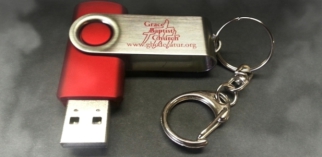
All 75+ series we offer
[reg. $50 ea.] for about $4
Over 2,000 files including sermon manuscripts, PowerPoints and handouts
4 GB drive even gives access to all our future series releases
 Print
Print 