
Microsoft Word document [27.3 KB]

Microsoft Power Point presentation [7.9 MB]
Jesus’ 4 Point Outline
Luke 4:18
Jesus had heard many, many sermons in His lifetime. Every Sabbath day they heard preaching and every week there would be days during the week, a Tuesday, a Thursday, a Wednesday, a Friday when they would go to the synagogue and they would hear a reading of Scripture and another exposition of Scripture. They were used to this. And the greatest subject for them to deal with was the hope of Messiah's coming. And so it was very common that they would hear the message of Messiah, particularly, of course, when the prophets were read, but even when the Mosaic law was read and they were brought again under the condemnation and obligation of the law, there could be a declaration of the fact that there was going to come finally the ultimate sacrifice, the one who would make the final atonement for sin. Now Jesus reads about the same and says, “today this scripture has been fulfilled in your ears.”
A summary of His main points is in verse 18, which is based on Isaiah 61. His ministry is here defined. When the Messiah comes, what is it that He will do? It says He will preach the gospel to the poor. He will proclaim release to the captives, recovery of sight to the blind and set free those who are downtrodden, in proclaiming the favorable year of the Lord. His ministry then is described in a series of phrases in verse 18, phrases built around infinitives that describe the work of Messiah, the work of salvation. And there are four metaphors: the poor, the prisoners, the blind, and the oppressed. These four metaphors describe the unredeemed, they described the unsaved, they describe the lost, the unconverted, the unforgiven. They sum up the work of salvation. He preaches good news to the poor, release to the prisoners, sight to the blind, and freedom to the downtrodden, or oppressed. Each of these provides for us a picture of the sinner in the desperate condition of his need.
When you think about the unconverted in the world, this is how you are to view them. They may, in fact, be rich. They may, in fact, be free. They may, in fact, have no physical infirmities whatsoever, let alone blindness. And they may appear to be on the top of the world, eminently successful. But the fact of the matter is, any sinner falls into these categorizations. Apart from the salvation that Christ brings, they are poor, they are prisoners, they are blind and they are oppressed. This is the desperate condition of the sinner and until the sinner comes to a recognition of that condition, there will not be any compulsion to seek a solution. The problem with lost people today is that they don’t consider themselves as lacking anything. They are self-deceived by prosperity and worldly thinking. When we look at the world around us, we cannot look at them superficially. They may believe they have unlimited freedom, which is the way most sinners in our society live, feeling free to express themselves in any way they want. They may think they're on top of the world in terms of lifestyle. But the fact is, spiritually they are poor, they are prisoners, they are blind and they are oppressed. They must realize that in order for them to turn to the One who can deliver them. They must come to know that they are in a storm that they can't cope with and the end of the storm can be their demise. They have to see that there are no personal resources to which they can turn to solve their imminent deadly dilemma. And that is the point of what Jesus is saying here as He opens the meaning of Isaiah 61. When the Messiah comes He will deal with the poor, the prisoners, the blind and the oppressed. Let's take them one at a time.
The first purpose is to preach the gospel to the poor. You hear the word "gospel" a lot. It's simply a word for “good news.” The good news is not that poor people are going to get rich. The good news is not economic prosperity. The good news is not material enhancement. We're talking about spiritual riches here. The good news is to people who are spiritually impoverished, spiritually poor. The good news is you can be released from your poverty.
Let me talk about that word "poor," if I might, for a minute. The Greek language is a wonderfully rich language which has almost limitless nuances both in vocabulary and in word form. And here is a word that enriches our understanding greatly. It is the word ptochos. It is from a verb that means "to cringe" quite interestingly, or "to shrink back," or "to cower." It conveys the idea of a beggar. It is the word that refers to someone who cowers in the shadows. And in classical Greek the image was that one hand went out and the other hand went over the face to hide identity. This was so shameful. Here was a person who had reached the point of abject destitution. They are at a point of utter and total bankruptcy in life. It is used, by the way, to describe in Luke 16:20 Lazarus who was begging for crumbs. It is not the ordinary word for “poor.” The ordinary word for “poor,” penichros, means somebody who has very little money.
For example, the widow in Luke 21:2, the widow who had just a few pennies, she was poor financially. She had very little. But ptōchos means you have absolutely nothing in life at all, and that is the word here. The Messiah will come and bring good news to the people who are destitute, the people who have nothing. And spiritually speaking, this is talking about people who recognize that they have nothing by which to commend themselves to God. In Luke 6:20 Jesus says, "Blessed are ye poor, for yours is the kingdom of God." It's a repeat of Matthew 5:3, "Blessed are the poor in spirit," not in money, but the poor in spirit. That is the condition of every sinner. Every sinner is morally bankrupt. Every sinner, in the words of Isaiah, could count his righteousness as filthy rags. Every sinner is destitute of anything to commend himself to God. And, of course, this goes contrary to the Jewish mentality. They thought that by their good works and by their self-advancement by keeping ceremonial law, and obeying the Mosaic system, by being fastidious legalists they would earn salvation. And Jesus comes and shatters that entire view and says, "The only people to which Messiah is going to bring salvation are those who recognize their spiritual destitution." The Great Physician comes only for the sick, not those who think they are well. As long as you think you're a good person, as long as you think your religion/morality counts for something, you're damned to eternal hell and you have an irremediable condition. The poor are those, on the other hand, who recognize their total spiritual destitution. They are completely unable to recover without help. So the person who comes to the realization there are no saving resources available, they can only beg for mercy from God alone, they and they alone receive the grace of salvation. All pride is gone, all self-assurance is absent. They are utterly empty-handed, without commendation, who alone can turn to God and receive from Him what they cannot themselves generate.
They're like the publican in Luke 18 beating on his breast, "God, be merciful to me, a sinner." And he falls down and he won't even look up, he won't lift his eyes to even look toward heaven because he's cringing and cowering in his spiritual destitution. And next to him is the Pharisee saying, "I thank You that I'm not as other men, but I fast and I tithe and I do all these good things. Aren't I great?" And Jesus said the man begging, the man with his face down went home justified, not the other one. It is the state of spiritual bankruptcy then where a person really sees their own helpless condemnation.
The imagery is pretty graphic in a similar passage of Revelation 3 verse 17 where Jesus says, "Because you say I am rich and have become wealthy and have need of nothing, and you do not know that you wretched and miserable and poor and blind and naked," and there's all that same imagery again. Your problem is I can't help you because you don't understand your desperation.
Earlier He put it this way, "It is easier for a camel to go through the eye of a needle than for a rich man to enter heaven." His riches become a barrier to his entering the kingdom because he has no sense of his need.
James 2:5
5 Hearken, my beloved brethren, Hath not God chosen the poor of this world rich in faith, and heirs of the kingdom which he hath promised to them that love him?
The second picture is of prisoners. It's an equally graphic one. The sinner can also be viewed as a prisoner. It can mean prisoners of war, those who have been taken captive by some powerful source, brought into prison for crimes that they have committed and are awaiting their own execution. That's how He sees the sinner. The sinner is a prisoner.
You know, sinners today think they are free. In fact, they see Christianity as some kind of bondage, don't they? Everybody's got their rights and nobody is going to infringe on my rights, I can be what I want to be, I'm free to be myself. You hear that inane statement again and again. They are not free. The Bible defines them as prisoners. Sin has indebted them to God. They cannot pay that debt. Satan wields, according to Hebrews 2:14 and 15, the power of death and holds them in bondage all their lifelong by the fear of death. They are the children of wrath, of Ephesians 2:1 and 2 says, they are under the power and authority of Satan. So there's a sense in which they are captive to sin, captive to Satan.
Psalms 79:11
11 Let the sighing of the prisoner come before thee; according to the greatness of thy power preserve thou those that are appointed to die;
Isaiah 42:7
7 To open the blind eyes, to bring out the prisoners from the prison, and them that sit in darkness out of the prison house.
That's what God says. Back in the praise of Zacharias in chapter 1, verses 77 to 79, when the Messiah comes He will give His people the knowledge of salvation by the forgiveness of their sins. And then it says "release to the captives," that word “release,” means “forgiveness.” The way you are freed, the way a prisoner is freed is when his sin is forgiven, when his crime is forgiven. That's precisely what the Messiah will do. He will release the captives because He will forgive their sins. Forgiveness/pardon sets the prisoner free. The only reason we can be forgiven is because Jesus took our penalty. That's why Charles Wesley wrote in that great hymn of Christ, "He breaks the power of cancelled sin. He sets the prisoner free."
Thirdly, the blind, not physically blind, although Jesus did heal blind people. But He's talking here from Isaiah 61:1 about those who are in spiritual darkness, as was Zacharias. Again back in chapter 1 he talked about the Messiah as the Daystar from on high who would shine on those who sit in darkness and the shadow of death. There's a picture all through the Bible of spiritual blindness, spiritual darkness. The sinner is blind in the fact that he cannot see or understand the truth. Spiritual blindness is commonly discussed in the Bible. It is natural to fallen man. Psalm 82:5, "They do not know nor do they understand. They walk about in darkness." Jeremiah 5:21, "Hear this now, oh foolish people without understanding, who have eyes and see not, and who have ears and hear not." This is the state of the unconverted. "The natural man understands not the things of God, he can't know them, he can't understand them because they're foolishness to him."
Judicially, there’s another category of blindness, because God has blinded him. John 12:40, "He has blinded their eyes and hardened their hearts lest they should see with their eyes, lest they should understand with their hearts and turn and be converted," and that's quoted from Isaiah 6.
Isaiah 29:10
10 For the LORD hath poured out upon you the spirit of deep sleep, and hath closed your eyes:
A man is further blinded by Satan.
2 Corinthians 4:4
4 In whom the god of this world hath blinded the minds of them which believe not, lest the light of the glorious gospel of Christ, who is the image of God, should shine unto them.
And then Romans 1 says this is the reason that when we know there’s a God but we don't honor Him as God then our foolish hearts are darkened.
That's why you can take the greatest scientists in the world, you can bring them together, let them discuss origins or anything else that relates to the creator God, and the supernatural dimension and they are utterly unable to come to the right answer, to say nothing of salvation. The natural man cannot solve the dilemma of his blindness spiritually on his own. John said unbelievers hate the light, John 3:19 and 20, "because their deeds are evil and they love their evil deeds.”
So what does the Messiah come to do? It says in verse 18, "To give sight to the blind." Isaiah 42:7: "To open blind eyes." John 8:12, Jesus says, "I am the light of the world, he who follows Me shall not walk in darkness but have the light of life." Second Corinthians 4:6: "It is God who commanded light to shine out of darkness, who has shone in our hearts to give the light of the knowledge of the glory of God in the face of Jesus Christ." When you realize you're in blackness and darkness and you come to the Messiah, He gives light. "Once you were darkness," Ephesians 5:8 says, "now you are light in the Lord." Colossians 1:13, "He has delivered you from the power of darkness and taken you into the kingdom of the Son of His love." The light shines in the heart of one who meets the Messiah.
In Acts 26 Paul gives his testimony. He said to the Lord on the road to Damascus, "Who are You, Lord? He was blind but God opened His eyes - The Lord said, 'I am Jesus. Arise, stand on your feet, for this purpose I have appeared to you and now I am sending you to others to open their eyes so that they may turn from darkness to light.
And finally He comes to those who are called the downtrodden, or the bruised/oppressed. It's someone overwhelmed by the pain of life, overwhelmed by relationships that are abusive, overwhelmed by illness, overwhelmed by whatever kind of troubles life can bring to bear. This is the afflicted person, this is the distressed person who has lost all joy. This is the person to whom Jesus spoke when He said, "Come unto Me all you that labor and are heavy laden." This is the person who is overburdened.
And what is that oppression? It is sin. It is the weight of the law, being unable to be good enough. The Pharisees bound on the people all kinds of law, as Matthew 23 tells us, and they didn't help the people to carry it and the people were crushed under this absolutely wearying, heavy burden of trying to keep the law of God which they couldn't keep.
1 John 5:3
3 For this is the love of God, that we keep his commandments: and his commandments are not grievous.
We are the poor who have been made rich spiritually. We are the captives who have been set free. We are the blind who now see. We are the oppressed who have been delivered. For all true believers it continues to be the acceptable year of the Lord. It isn't just a year; it's a lot longer than a year because we're still in it even today.
Paul said it, "Today is the day of salvation." It's the time for sinners to admit it and repent and come to the Messiah and be forgiven and receive God's salvation.
Book is free with purchase of our Flash Drive, below
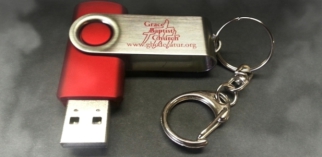
All 75+ series we offer
[reg. $50 ea.] for about $4
Over 2,000 files including sermon manuscripts, PowerPoints and handouts
4 GB drive even gives access to all our future series releases
 Print
Print 