
Microsoft Word document [25.1 KB]

Microsoft Power Point presentation [6.4 MB]
The Last Passover – The First Communion
Luke 22:14-23
This is epic. This is monumental. This is a turning point in all redemptive history. We go from Passover to communion, or the Lord’s supper. Jesus shifts gears. It’s the last supper in the upper room. To put it another way, on this evening Jesus brings to an end the old covenant and inaugurates the new covenant, the New Testament. He ends millennia of a celebration looking back to God’s delivering power in Egypt and now He inaugurates a new memorial of looking to the cross and the far greater deliverance accomplished there.
Let me tell you a little bit about the Passover. Israel had been in Egypt in bondage for over 400 years. God delivered them by the leadership of Moses through a series of plagues. The final plague was the death of the firstborn; the angel of death came and killed the firstborn in every family, unless you had sacrificed a lamb and splattered the blood on the doorpost and the side beams, the 3 points of the cross. Then the angel of death passed by.
There’s a simple principle that comes through, and it is this: To be delivered from judgment requires death. And that death can be the death of a substitute. God was saying, “I will spare you. I will deliver you from this judgment if there is the death of an innocent substitute.” From then on, all sacrifices were reminders/memorials that God delivers from judgment by the death of a substitute.
But the animal sacrifices weren’t really that substitute. No person was ever delivered from divine judgment by the death of any animal. The repeated sacrifice of animals was simply a continual symbol of the fact that God does deliver by the death of an innocent substitute, but no animal was ever satisfactory to God and so the sacrifices went on and on by the millions. And so the people waited for a sacrifice that would be satisfactory to God, to which all those previous sacrifices pointed. That day finally came on a truly black Friday when the Lamb offered Himself as a sacrifice, a substitute for sinners, and the Father poured out His wrath on that innocent substitute.
In verse 14, it is Thursday night of Passover week. On the morrow, Friday, at exactly the hours of slaughter, between three and six when all the Passover lambs had to be killed, the lamb of God would die in that same period of time.
That was the last Passover. No longer did there need to be animal sacrifices pointing to the One who would come because once He came the shadows all disappear into the reality.
v. 15 This is very strong language. Whenever the Greeks want to emphasize something, they repeat it, like from glory to glory, or grace upon grace. It’s just a way to intensify what is being said. This is emphatic; this is passionate. It’s as if Jesus is saying, “This has to happen. This is essential.” I have earnestly desired, with great desire, to eat this Passover with you before I suffer.
He knows it’s just hours away. He knows He’s going to be arrested this night. He knows He’s going to be put through mock trials in a kangaroo court. He’s going to be put on a cross and He’s going to be dead and in the grave before the next sun goes down. He knows that. This is no surprise.
This wasn’t His first Passover – He had celebrated one every year of His life – but this one would be more powerful, more emotional, more vivid, more dramatic than any Passover ever in His life because everything was about to burst upon Him and He would be the slaughtered Lamb of God to take away the sins of the world.
I can’t even imagine the power of the emotion He was feeling, but it began to surge and well up even at this time when He began the Passover with strong, intense desire to do this. Emotions swelled, and they were nearly overpowering to Him. A few hours later, when He went into the Garden, He was sweating – as it were – great drops of blood as the knowledge of coming trauma to His own physical body began to cause His capillaries to disintegrate under extreme duress. The pressure of these emotions are beyond our comprehension. He had seen lots of animals sacrificed all His life and knew that one day He would be that sacrifice. But it was all imminent at this moment. His suffering was of supernatural proportions.
v. 16 It’s the end of Passovers. This is His last meal before His cross. But it is more importantly His last Passover. He ate the lamb, and then He became the Lamb.
Will there ever be another Passover where Jesus eats with His own? Yes. Back to verse 16, “...until it be fulfilled in the Kingdom of God.” Look at verse 18, “...I will not drink of the fruit of the vine, until the Kingdom of God shall come.” Both verses indicate that yes, there will be another meal; yes, another time when we gather around His table and celebrate the Passover. There will be a reinstitution of the Passover – not to point back to the exodus, but to point to the cross because the Passover was designed not only to commemorate the exodus, but to point to the sacrifice of Christ.
By the midpoint of the tribulation a temple is coming soon in Jerusalem. By the end, the victory will be won by Jesus Christ and the Lord will reign over the whole earth in the 1,000 year millennium; and in that temple there will be ceremonies and there will be sacrifices and there will be a Passover. It’s spoken of in…
Ezekiel 45:21
… ye shall have the passover, a feast of seven days; unleavened bread shall be eaten.
But until that millennial Kingdom, He will never celebrate the Passover with His people again. There is no legitimate Passover until the Millennial Passover. I know Jews all over the world celebrate the Passover. It means a lot to them traditionally and historically, and that’s fine. But if you reject Jesus Christ, your religion is false, and your Passover is meaningless.
And then the Passover begins in verse 17. This is another cup, previous to the meal, but notice the thanksgiving here. The Greek verb for thanks, eucharisteō is the word from which we get eucharist, which means to give thanks, and the Lord’s table is often called the eucharist. That was the final Passover. God instituted it in Exodus 12, and God incarnate ended it on a Thursday night, hours before His death.
So we come to the first communion – in verses 19-20.
I feel really unable to convey anything that comes close to the monumental transition that’s going on here, to bring to an end in just those simple statements the whole old covenant, the entire Old Testament, to pull the curtain down, and to launch something brand new – it is stunning.
This is the end of the whole ceremonial law: all the dietary laws, all the Sabbath laws. In fact, there’s no more Sabbath. Immediately after this, the church starts to meet – when? The first day of the week. The ceremonial law is over. However, the moral law doesn’t change because God doesn’t change. This is the end of all the sacrifices. This is the end of all the bloody altars. This is the end of the priesthood. This is the end of the holy place. This is the end of the Holy of Holies, and God would split the curtain from top to bottom and throw it wide open for anybody and everybody to walk in and out. This is the end of everything that they knew that had been symbolic. It’s about to get real!
He dies, He rises, and they meet on that Sunday and they are a priesthood, and there is no more sacrifice ever again until the Lord institutes some memorial sacrifices and the new Passover in the Millennial Kingdom.
Now go back to verse 19. “This is My body,” – please, He does not mean this is actually His body, as the Roman Catholic Church has said for centuries; that is ridiculous. In the first place, His body was there fully intact, and the bread was in His hand. On another occasion Jesus said, “I am the vine.” We know what He meant by that. We don’t think He’s a plant. The bread is a picture of His body. In the scripture, He’s the rock. He’s the cornerstone. He’s the head. When He says He’s the head of the body, we understand that He is meaning that figuratively. We reject the foolishness of transubstantiation, that bizarre idea that when the priest blesses a piece of bread it literally becomes the actual physical body of Jesus which you eat, or that the cup becomes His literal blood. That’s nonsense. We aren’t vampires.
That phrase, “Which is given for you,” is the most important concept in the entire Bible. It is the teaching of the substitutionary death. The Passover taught us that you escape judgment only by death; and that death can be the death of an innocent substitute. Isaiah told us, “He was wounded for our transgressions. He was bruised for our iniquities. The chastisement [that brought us peace with God] fell on Him. By His stripes we are healed.”
How could Jesus take the full wrath of God for all the sins of all who would ever believe and pay for it all in just a portion of three days. The only answer to that is He’s an infinite person who suffered infinitely. We can’t begin to comprehend it. But we will do what v. 19 says and give thanks.
v. 20 says “likewise,” meaning “in the same way,” we give thanks for the cup, picturing the blood of Christ which washes away our sins.
“God treated Jesus on the cross as if He lived your life so He could treat you as if you lived His.” He was wounded for our transgressions; and bruised for our iniquities.
So from now on, there’s a new feast, the new ordinance, a new supper, the Lord’s supper – the bread and the cup reminding us of the Lamb of God.
Paul said, do this as often as you drink it in remembrance of Him. No more Passover. Now, the Lord’s table. And in a sense He presides over it every time we gather at His table.
Book is free with purchase of our Flash Drive, below
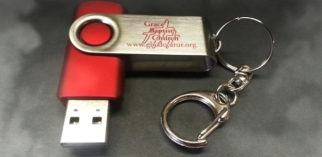
All 75+ series we offer
[reg. $50 ea.] for about $4
Over 2,000 files including sermon manuscripts, PowerPoints and handouts
4 GB drive even gives access to all our future series releases
 Print
