
Microsoft Word document [28.9 KB]

Microsoft Power Point presentation [8.3 MB]
Please, Call Me Peter
Luke 6:14
The gospels literally are filled with his name. His name is mentioned more than any name but that of Jesus. His name is always the first at the head of every list, and I'll tell you why. He, Simon Peter, is the leader.
Matthew 10:2
Now the names of the twelve apostles are these; The first, Simon, who is called Peter, and Andrew his brother; James the son of Zebedee, and John his brother;
It doesn't mean the first in a list. It means the chief, the leader. Let’s talk about him, starting with his name. Simon Bar-Jona. That is indicated to us in Matthew 16 by Jesus. Jesus calls him Simon Bar-Jona and in John 21 Jesus calls him Simon, son of Jonah, or Jonas, or John. The word bar, means "son of." When someone has a Bar Mitzvah they become a son of the law.
v. 14a The Lord gave him another name. I think this is important to note the language, "whom He also named Peter." He didn't say you have a new name to replace the old one. He also called him Peter. He was Simon and he was also Peter. Now how many of you grew up being called by more than one name? Was it when you were in trouble?
When Jesus first met Peter, John 1:42, He said, “You used to be called Simon. I want to call you Cephas.” That's the Aramaic word for Peter. The Greek word is Petros. Both words mean rock. His new name was rock, Rock Bar-Jona.
Now why does Jesus do this to him? Well, the Lord has a purpose in mind. I mean, by nature this guy was brash, vacillating; he made great promises of what he would do and didn't follow through. He was one of those – the kind of guys that go whole-hearted into something and then bail out; first one in, first one out. The Lord changed his name, I think, because He wanted to work on him in an immediate way. And it was very easy to do once He gave him the name Rock, because it sent him a message. If He called him, "Simon," then it meant he was acting like his old self. If He said to him, "Peter/Rock," he was acting the way the Lord wanted him to act. Jesus wants to remake Simon Peter in His image. Christ is the cornerstone, and He wants Peter to be a chip off the old block!
Problem: Simon was naturally impulsive, but he needed to be a Rock. And each time the Lord addressed him He was teaching him lessons. If he called him Simon, he got one message. And after his name was changed you can see a consistency in how those names were used. Whenever he is called Simon, it is in one of two contexts, a secular context or a sinful context.
Secular: When referring, for example, in Mark 1:29, Luke 4:38, Acts 10:17, to Simon's house. That's a secular context, Simon's house. It has nothing to do with spirituality; Simon's mother-in-law, Mark 1:30, Luke 4:38; Simon's boat, Simon's fishing partners, Luke 5:10. So when referring to Simon in purely the secular element, he is the old Simon.
The second category in which he's called Simon: sinful. Whenever there was sin there he was also dubbed Simon. You find that even back in Luke 5:5, "Simon answered”, “we worked all night, and caught nothing." This is old faithless Simon, the fisherman. But finally he starts to make some spiritual responses and in verse 8 he becomes Simon Peter. So we see him there in transition. "Simon Peter fell down at Jesus' feet, ‘Depart from me, I'm a sinful man, oh Lord.’" Simon, who was saying, "Oh Lord, I've been fishing all night, what kind of a ridiculous thing is this? You tell me to cast the nets on that side of the boat. Do you think the fish know the difference? I mean, we know what we're doing out here." That’s Simon. But, “Lord, I'm a sinful man," that's Peter, that's the man who sees himself the way God wants him to see himself. So, when you see him addressed then as "Peter," it's a good sign.
In John 21 [Christ has risen from the dead] Jesus says, "Okay, go to Galilee, and I'll appear to you there, wait for Me." They go there. Peter says, "I'm not waiting any longer, this is getting ridiculous. I don't know if I can do this. I'm going to go back and take up my fishing business." He goes down, gets in his boat, gets his nets, all his ropes, and the others echoed, "And we're going with you." And like a line of ducks they all waddled down to the shore, got on the boats and went back to fishing. And Jesus showed up and rerouted all the fish so they couldn't catch any. And they came into shore and Jesus made breakfast. The disciples come to the shore, and Jesus looks at Peter and He says this, "Simon, Simon, do you love Me?"
"Yes, I love You."
Second time, "Simon, Simon, do you love Me?"
"Yes, I love You."
"Simon, Simon, do you love Me? Then do what I told you. Feed the sheep and the lambs. If you love me, keep my command. Minister."
That's Simon.
Luke 22:31
31 And the Lord said, Simon, Simon, behold, Satan hath desired to have you, that he may sift you as wheat: [the devil wants him to regress back to being Simon]
Mark 14:37 [in Gethsemane]
37 And he cometh, and findeth them sleeping, and saith unto Peter, Simon, sleepest thou? couldest not thou watch one hour?
It must have gotten to the point where whenever the Lord said "Simon," Peter just cringed. "Please call me Rock." To which the Lord could have replied, "I'll call you Rock when you act like a rock."
John knew Peter really well. Seventeen times in his gospel, John calls him Simon Peter. I love that. John couldn't make up his mind because he saw both sides all the time. So he just decided to go with "Simon Peter." Sometimes Simon, Sometimes Rock.
Peter was like all of us, wasn't he? Carnal and spiritual, functioning in the flesh sometimes, functioning in the Spirit sometimes, sinful sometimes, righteous sometimes.
Now this guy is the leader of the twelve. Boy, how the Lord disdained self-righteous people. And nothing about Peter is self-righteous. This is the greatest and most prominent preacher of the twelve. This is the man who more than any other apostle, laid the foundation of the church, followed up by the later arriving Apostle Paul. Peter is the hero in the first twelve chapters of the book of Acts. And this man, this man was as much Simon as he was Peter. And I say again to you what I'm going to say through the whole series, if God couldn't use the unworthy and the unqualified, He wouldn't use anybody.
When you look at Peter you can see how God builds a leader. Nobody speaks as often as Peter and nobody is spoken to by the Lord as often as Peter. No disciple is so reproved by the Lord as is Peter, and no disciple reproved the Lord, but Peter. No disciple ever so boldly confessed and outspokenly acknowledged the lordship of Christ as Peter, and no one denied it as boldly as Peter. No one is so praised and blessed as Peter, and no one else is called Satan, but Peter. [“get thee behind me”] The Lord had harder things to say to Peter than He ever said to anybody else and that was part of making him the man He wanted him to be; the leader Christ desired. God took a common man with an impulsive, unsubmissive personality and shaped him into the leader of the twelve, the greatest preacher out of the apostles, and in every sense the real power of the first twelve chapters of Acts.
Here’s an age-old question: are leaders born or made? I believe that they are born, and then shaped.
Peter had that God-given fabric woven into his personality to make him a leader. He was the right raw material. And the Lord wove that in his mother's womb. There are some critical characteristics of leaders which cannot be developed, for they are inborn.
Inquisitiveness
When you're looking for a leader, find somebody who asks a lot of questions. People who don't ask questions don't wind up as leaders. Curiosity is critical to leadership. People who are content with what they don't know and content with problems they haven't solved can't lead. Leaders must have an almost insatiable curiosity to solve what they don't know. They understand that knowledge is power. Whoever has the information has the lead. If you want to find a leader, look for somebody who asks a lot of questions.
Some of you have kids like that. You have maybe one kid out of your little batch and this kid just asks question after question. And you get weary answering all the questions. That's the fabric of leadership. This tremendous internal drive to know what they don't know and understand what they don't understand is all about solving problems. And you've probably got another kid who sits in the corner quietly and never asks anything. He'll probably grow up and be a computer guy who will work for your other kid.
In the gospels, Peter asks more questions than all the other apostles combined. It was probably all day every day for Jesus. "Yeah, Peter, just a minute, I'll answer you as soon as I'm done healing this leper."
We say there are three kinds of people. There are people who make things happen, there are people who watch things happen, there are people who say, "What happened?"
Inquisitiveness
Initiative
If a man is to be wired for leadership, he has to be a self-starter. He has to be the kind of person that makes things happen. Peter not only asked all the questions, he was always the first one to answer any question posed by Christ. And he would just dive in where angels fear to tread. Jesus said, "Who do people say that I am?" Peter didn’t hesitate. "You're Christ the Son of the living God." The other guys are still processing the question. Peter was very fast. That's a part of leadership, quick on the trigger. And sometimes he had to reel back, undo, unsay, be rebuked;
Matthew 16:18
And I say also unto thee, That thou art Peter, and upon this rock I will build my church; and the gates of hell shall not prevail against it.
Then Jesus said I’m gonna be killed and Peter said, “Not gonna happen!”
Then v. 23…
Matthew 16:23
But he turned, and said unto Peter, Get thee behind me, Satan: thou art an offence unto me:
…but it makes the point that it's part of leadership to grab initiative by the throat.
Then in the Garden of Gethsemane, John 18, here comes the Roman soldiers from Fort Antonia, hundreds of them. They've come to take Jesus. Peter immediately, swish, pulls out his sword, takes a swing at the head of the first guy, Malchus, the servant of the high priest. Peter tried to cut his head off. He ducked, and lost his ear. The Lord says, "Put your sword away, Peter. You live by the sword, you die by the sword." Now think about it: There's a whole Roman army there, so what does Peter think he's going to accomplish? Go through the whole group, one at a time? Sometimes initiative doesn't examine the big picture. It's just boom. But that's the stuff of leadership.
But I'd rather reel back somebody like that than to have to try to motivate somebody to take initiative. There are some people you just have to drag kicking and screaming in any forward direction. Not Peter. He always wanted to know what he didn't know. He was the first one to ask a question and he was the first one to answer the question, take the initiative, and charge ahead, and that's the stuff of leadership. But it's got to be shaped. What I'm talking about here is raw material. It's going to be very critical for Peter.
In the future he's going to need some kind of moxie, some kind of courage to stand up in Jerusalem on Pentecost and preach the gospel in the face of the population that had just executed their Messiah. We’ll see that by the time the Lord has shaped his great initiative, it’s been transformed into boldness.
Inquisitiveness, Initiative
Involvement
A true leader is in the middle of the action. A true leader is not sitting in the background telling everybody what to do while he lives a life of comfort away from the fray. A true leader goes through life with a cloud of dust around him. And that's why people follow him. People don't follow somebody who’s far off, somewhere else. They follow somebody in the battle.
Jesus comes one night. He's walking on the water. And who out of all the disciples jumps out of the boat? Peter. There's the Lord, I'm here, I've got to get where the action is, bang, he’s out of the boat. And he's walking on the water. And the rest of the disciples are just looking over, just kind of adjusting, trying to make sure they don't fall overboard in the storm. And he's out on the water. This is serious involvement. Jesus was there, he was here, and immediately, instinctively, he had to close the gap.
He took his eyes off Christ and began to sink. So people criticize Peter's lack of faith. But where were the other eleven? They never got out of the boat. Before you criticize Peter, remember where he was when he began to sink. He was standing on top of water! And that was another day that Jesus conformed him into His own image. What a learning experience!
People look at Peter's life and they say, well, he denied the Lord repeatedly the night of Jesus’ trial. But before you condemn Peter too quickly, the reason he was alone in that position where such a temptation could hit him hard because he was doing his best to stay as close to Christ as he could. That's a leader. Everybody else may bail out. He stays as close to the action as he can get.
That’s the raw material that was in Peter, that kind of inquisitiveness, that kind of initiative, that kind of involvement. Now the Lord will start shaping him. Frankly, if this raw material is not shaped by the Lord, it could be disastrous. Next time we're going to see how the Lord took him through experiences that shaped him and developed the virtues that made him the man he became.
Earlier we looked at…[v. 31, now see v. 32]
Luke 22:31-32
And the Lord said, Simon, Simon, behold, Satan hath desired to have you, that he may sift you as wheat: 32 But I have prayed for thee, that thy faith fail not: and when thou art converted, strengthen thy brethren.
You don’t have to remain a Simon. You can become a rock!
Book is free with purchase of our Flash Drive, below
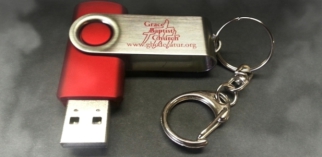
All 75+ series we offer
[reg. $50 ea.] for about $4
Over 2,000 files including sermon manuscripts, PowerPoints and handouts
4 GB drive even gives access to all our future series releases
 Print
Print 